Shasta College Honored with Board of Governors Energy and Sustainability Award for Composting and Clean Energy Efforts
DATE: March 27, 2026
CONTACT: Shasta College President’s Office
RELEASE: FOR IMMEDIATE RELEASE
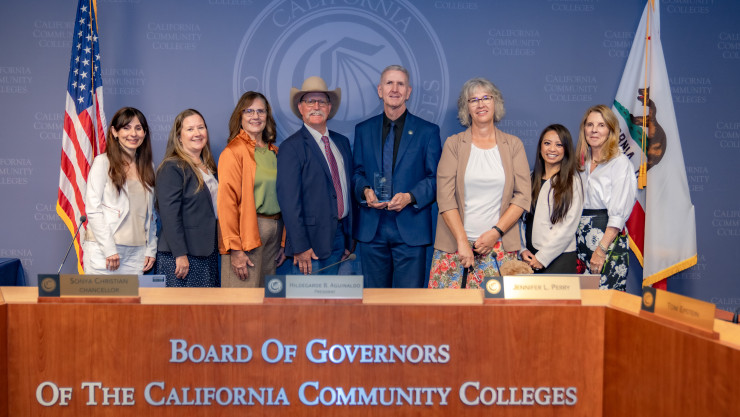
REDDING, CA – Shasta College’s school color reflects its commitment to “green” innovations, and those efforts were recognized on March 24, 2026, by the Board of Governors in Sacramento. Superintendent/President Dr. Frank Nigro, along with Dean Mark Klever, Horticulture instructor Leimone Waite, and Director of Food Services Denise Axtell, were present to receive the 2025 Excellence in Energy and Sustainability – Innovative Project award. The project, dubbed “Carbon Sinks,” is a collaborative effort led by the college’s Food Services and Ag/Natural Resources teams, with help from College Corps students to dispose of green waste in a way that is carbon neutral and benefits the college’s working farm, which is run by students, and instructional faculty. College Corps students ensure that the waste from the college’s cafeteria is collected twice a week and transported to the farm where dorm students, who help operate the 150-acre farm and horticulture area, assist with the composting process, which is then tied into various components of their curriculum.
Twice a year, all compost generated is spread on the farm’s fields, turning waste into nourishment—and learning opportunities for students. The college also uses the worm casting harvested from the worm bins in potting mixes at the campus nursery and in planting areas in the campus arboretum.
“We are honored as a college to again be recognized at the state level for the innovative excellence this team of individuals took on and made a success,” said Dr. Frank Nigro, Shasta College Superintendent/President. “This was truly a collaborative effort across a number of campus departments and is an excellent, low- or no-cost example of the hands-on learning environment we integrate into every aspect of our college culture, both in and outside of the classroom. The success of this effort stems from the vision our Director of Food Services, Denise Axtell, championed for many years, and the collaborative approach from both our horticulture and ag program areas. The College Corps students were the final, critical element who ensured all of the pieces moved where and when they needed to make this the success we see today.”
Combined with ag waste, the college diverts an estimated 635 cubic yards (more than 128,000 gallons) of material annually. Food scraps from the campus kitchen comprise up to 600 gallons during the academic year—and are composted in affectionately nicknamed “worm bins.” The process yields nearly 2,000 gallons of compost from food waste annually. Meanwhile, the college’s Agriculture and Horticulture departments produce substantial organic waste from livestock barns and plant clippings that are added to a large compost pile. With over 625 cubic yards of agricultural waste collected annually, composting this material is vital to soil health on the Shasta College Farm, where students study sustainable ag practices firsthand.
The college just received notice that additional funding from the state College Corps program was awarded to expand this project to collect all campus green waste for a larger worm composting project slated to start in 2027. As part of that initiative, the college plans to offer a non-credit composting class to the community, which College Corps fellows will be involved in.