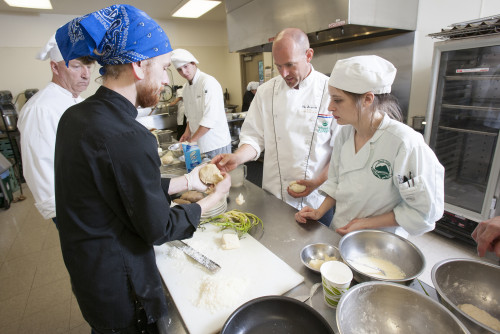
Provides students with the opportunity to meet the requirements for transfer to a CSU and major in Hospitality Management.
Associate in Science for Transfer | SC Program: AS-T.2006
The course of study in hospitality includes instruction in hotel and restaurant operations designed to prepare students for various positions in the hospitality industry. Excellent job prospects exist with employers at hotels/motels, restaurants, clubs, cafeterias, food manufacturing companies, contract food service providers, schools, airlines, railways, and cruise ship companies.
The Associate in Science in Hospitality Management for Transfer Degree (AS-T Hospitality Management) provides students with the opportunity to meet the requirements for transfer to the California State University system in Hospitality Management. In order to earn this degree a student must complete 60 required semester units of CSU-transferable coursework with a minimum GPA of 2.0. Completing this degree guarantees admission to the CSU system but not to a particular campus or major. The degree is designed to prepare students for upper division study in Hospitality Management.
Hospitality Management graduates at the bachelor’s level are qualified for employment by industry in a variety of jobs, in areas such as food and beverage management, safety and sanitation, culinary operations, and lodging in this transfer program.
Choose your path
Map your education by viewing the program map for the degree or certificate you’re interested in earning below. Meet with a counselor to create your official comprehensive education plan.
A program map shows all the required and recommended courses you need to graduate and a suggested order in which you should take them. The suggested sequence of courses is based on enrollment and includes all major and general education courses required for the degree.
Fall Semester, First Year
16Units Total
ENGL C1000
GE
General Education
4
4 Units
Academic Reading and Writing
ENGL C1000
Units4
Note: For students who would benefit from further instruction and individual support while taking their first college-transfer level English course, ENGL C1000E is a recommended alternative to ENGL C1000.
In this course, students receive instruction in academic reading and writing, including writing processes, effective use of language, analytical thinking, and the foundations of academic research. An argumentative research essay is required for the successful completion of the course. This course may be offered in a distance education format.
This course is an introduction to statistical thinking and processes, including methods and concepts for discovery and decision-making using data. Topics include descriptive statistics; probability and sampling distributions; statistical inference; correlation and linear regression; analysis of variance, chi-squared, and t-tests; and application of technology for statistical analysis including the interpretation of the relevance of the statistical findings. Students apply methods and processes to applications using data from a broad range of disciplines. This course may be offered in a distance education format.
This course is an introduction to nutrition science, integrating concepts and research from biology, biochemistry, microbiology, physiology, and psychology to explain the interaction between nutrients and the human body. It explores the biological basis of nutrient standards and examines the effects of nutrition, behavior, and exercise on human health. Physical and biological sciences are connected to nutrition and physiological processes, exploring the interconnectedness of physical and life sciences in the context of real-world applications. This course may be taught in a distance education format.
This course offers an overview of the structure and relationship of components within the hospitality and travel industry. Economic and employment impact and review of food service, lodging, resorts, recreation enterprises, attractions, cruise, destination bureaus, travel agencies and related operations. Focuses on orientation to customer service, cultural/economic trends and career opportunities. This course may be offered in a distance education format.
This course will provide instruction in the proper use of safety and sanitation principles and practices for personal and institutional application. Methods and techniques for handling foods safely are examined, including food preparation, storage, service, and the prevention of food contamination. Also covered are the importance of microorganisms, foodborne illness and food allergies, sanitary facilities and equipment, accident prevention, crisis management, and pest management. Compliance with city, state, and federal health regulations as embodied in HACCP (Hazard Analysis Critical Control Point) are emphasized, along with the supervisor's responsibilities in maintaining high standards of these principles. This course will provide updated information on USDA, FDA, Codex, and ISO 24,000 regulations and their relationship to food borne illness. This course also covers the safe use of culinary equipment and its proper use to avoid accidents. The student receives a certificate of completion from the Educational Foundation of the National Restaurant Association upon the successful completion of this course with a passing grade of 75% or higher. This course is required for all Culinary Arts/Culinary Management students and is advised to be taken as the first course prior to all other culinary courses or in conjunction with the first few. It may be used for American Culinary certification and recertification, and is required for the Dietary Service Supervisor Certificate offered by the Nutrition Department. This course may be offered in a distance education format.
In this course, students learn and apply foundational rhetorical theories and techniques of public speaking in a multicultural democratic society. Students discover, develop, and critically analyze ideas in public discourse through research, reasoning, organization, composition, delivery to a live audience and evaluation of various types of speeches, including informative and persuasive speeches. This course may be taught in a distance education format.
This course covers principles of organization, management, and decision models applied to the tasks and challenges of hospitality operations. The course involves techniques of problem solving (including planning, organizing, staffing, directing and controlling operations) in areas of front office operations, housekeeping, personnel, and security. The course also examines a systematic approach to front office procedures by detailing the flow of business through a lodging operation, beginning with the reservation process and ending with check-out and settlement. This course may be offered in a distance education format.
Advisory: English Placement Level 5 or higher (ECON C2001 is not a prerequisite for ECON C2002)
An introductory course using microeconomic models to understand individual decisions by consumers and firms, market outcomes including market failure, elasticity, market structures, labor markets, inequality, and the impact of government policies. This course may be offered in a distance education format.
In this course, students will learn in a live environment, the skills and techniques of the "front of the house" service staff. Throughout this course, students will rotate through basic dining room positions, learning and practicing their skills in front of dining room guests, in our public dining facility. Emphasis will be on the basic serving techniques and on customer satisfaction.
Please see a counselor to discuss options for meeting general education requirements for transfer to California State Universities (CSU) and/or University of California (UC) campuses, as well as any specific additional courses that may be required by your chosen institution of transfer.
*Alternative Courses: Please see a Shasta College counselor for alternative course options. You can also view the following to find other courses to meet degree/certificate requirements: